Jersey Guides
Retro Soccer Jerseys: Season, Fit and Printing Guide
Sep
A retro soccer jersey is easiest to choose when you separate four decisions: the design and season you want, what the seller says the item actually is, the measurements you need, and the printing you want on the back. An old year in a product title describes the represented design; it does not, by itself, establish when that particular garment was manufactured.
This guide is for supporters choosing a shirt to wear or give as a gift. It is not an authentication service or a guide to buying investment memorabilia. KK Jersey is an independent retailer, and the examples below describe current product listings rather than verified original-era or match-worn shirts. Start with the retro jersey collection, then check the exact product page before ordering.
Retro, vintage and reissue: what should you ask?
These labels are not interchangeable evidence. Sellers use “retro” broadly for older designs, while buyers often use “vintage” when looking for garments actually made in a past period. A reissue is a later release of an earlier design. The useful question is not simply whether a shirt looks old, but what the seller can substantiate about the item being supplied.
| Listing description | What to establish | What not to assume |
|---|---|---|
| Retro shirt | Represented season, design, current measurements and package contents | Original-era manufacture or official licensing |
| Original vintage shirt | Item-specific provenance, condition, labels and measurements | That a year in the title proves its age |
| Official reissue | The named brand or club release and the actual item offered | That every similar-looking shirt belongs to that release |
| Match-worn or player-issued item | Evidence specific to the garment and the claim | That a player name or number proves match use |
There are documented official reissues. For example, adidas announced an Arsenal 1992–1994 Bring-Back home jersey in October 2025. That announcement identifies a particular adidas release; it does not authenticate another seller’s similar-looking product. See the official adidas announcement for that distinction in practice.
Choose a season before choosing a player name
A useful shopping note contains the team, the season or tournament, and whether you want the home, away or third design. Add the sleeve length if it matters. “A blue Manchester United shirt” is less precise than the complete listing title, especially when browsing several decades at once.
Club-season labels commonly span two calendar years. Preserve the complete range when comparing listings rather than shortening it to a single year. A listing labelled 2004/06 also needs to be treated as its stated range, not silently changed to 2004/05. If you are trying to recreate a specific remembered match, check a reliable club archive or match photograph separately instead of assuming the product title resolves every detail.
Next decide whether the design itself or the player association matters more. A plain shirt may be the better choice if you like the colors but are unsure which name, number or competition font you want. A named shirt requires a closer look at the actual back image and the order options. There is no benefit in rushing that decision and discovering the mismatch after customization.
Use current listings as examples, not historical certificates
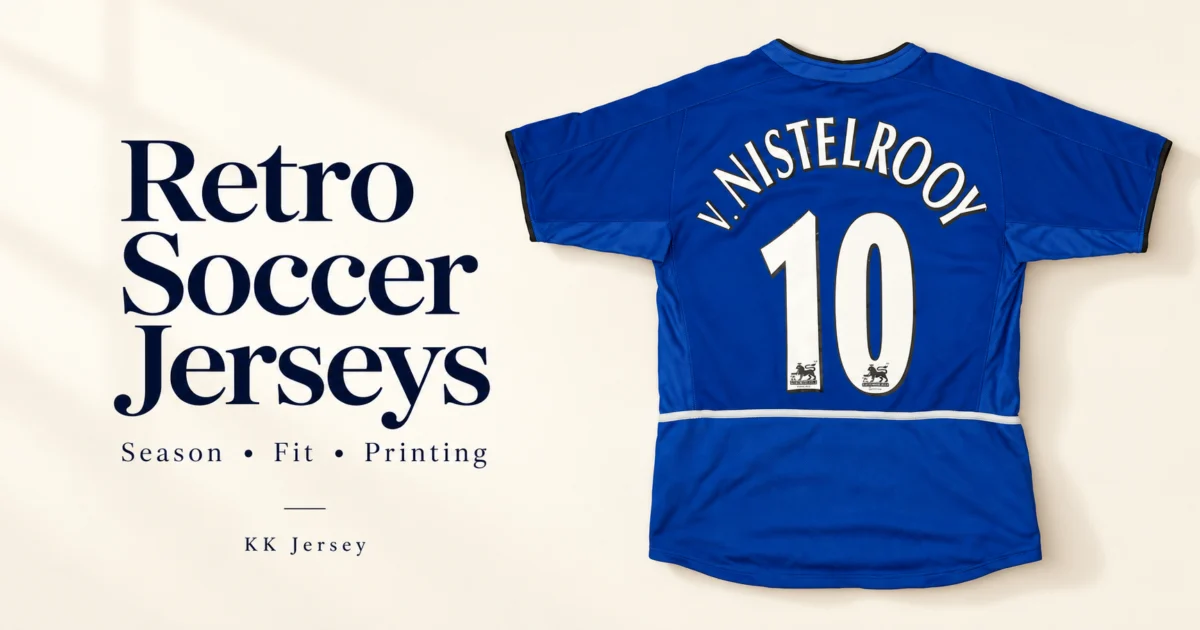
At the time this guide was prepared, KK Jersey’s v.NISTELROOY #10 Retro Manchester United Third Jersey 2002/03 listing was published and in stock. Its product details describe a blue fan-version shirt. The product photograph used for this guide shows the back with the name and number. That is useful for checking the offered design, but it is not evidence of manufacture in 2002 or use by the player.
For a different team and season, the Zidane #5 Retro Real Madrid Home Jersey 2005/06 listing provides another current browsing starting point. Its stated season should remain 2005/06. Neither example should be interpreted as a guarantee that every size remains available when you visit; check the live selectors and stock message.
Compare the two pages using the same questions: is the title clear, can you see the relevant front and back details, which size can you select, and what exactly is included? Do not compare the products solely by the fame of the player or a season you remember fondly. Those preferences help you choose a design, but they do not answer practical ordering questions.
Check the fit with a shirt you already own
Do not assume that every retro design has the same loose shape, or that your current-season shirt size transfers directly. The relevant information is the measurement chart for the item being ordered. A familiar letter size is only a starting point, particularly when moving between sellers or between fan, player, women’s and children’s products.
Lay a shirt that fits you flat and measure it using the same points described in the product chart. Distinguish flat chest width from chest circumference, and garment length from your height. If a diagram or unit is unclear, ask before ordering rather than multiplying or converting a value based on an assumption.
Think about how you intend to wear the shirt. If it will go over another layer, compare against a shirt that already gives you the room you want. If it is a gift, measurements from a suitable garment are more useful than guessing from the recipient’s height alone. Our soccer jersey size guide explains the measurement process in more detail.
Inspect printing as a separate decision
The name, number, font and patches should be checked independently of the shirt size. Read every character in the selected option, including punctuation and spacing. A product gallery can show one prepared example while the current selectors offer a different set of choices. If you want precisely the photographed back, confirm that your selections describe it.
A league font and a cup font may be different choices; do not infer that a patch automatically changes the name set. Similarly, a named product title does not explain whether additional personalization is possible. Only use options actually offered on that product page. See our name, number and patch guide before submitting a custom order.
Stop if the title, photo and selector disagree about a detail important to you. Contact info@kkjersey.ru with the product link and the exact discrepancy. A short question such as “Does this selection include the back print shown in photo two?” is easier to resolve than a general request for the best version.
Compare the whole order, not only the headline price
First establish whether the listing supplies a single shirt or a multi-piece set. Do not assume shorts or socks are included because a historical kit photograph shows them. Then check whether your chosen printing or patches affect the total. Comparing two different packages as if they were identical can make the lower headline price misleading.
Check destination-specific delivery information before choosing a shirt for a birthday, trip or match. An estimate is not a guaranteed arrival date. Review the shipping policy and allow for any preparation relevant to your selected order. For a firm deadline, ask about the specific item and destination before paying.
Read the return policy before adding personalization, since personalized orders have restricted return eligibility. Save the listing and order selections for your own reference. Do not use a general guide, an old social post or a screenshot from another product as a substitute for the terms attached to your purchase.
A practical final checklist
For two otherwise similar listings, make a small comparison note rather than relying on memory. Put the full product name, selected size, measurement units, back-print choice and included garments on separate lines. If the information comes from a photo rather than written specifications, mark that distinction. This makes it easier to ask a precise question and avoids carrying an assumption from one product into another.
After the shirt arrives, check the item against your saved order before removing labels, washing it or wearing it outside. If something differs, document the discrepancy and follow the retailer’s contact procedure. This is a practical order check, not a substitute for expert authentication of a garment sold as collectible memorabilia.
- Write down the team, complete season range and home, away or third design.
- Establish what the seller is claiming about the garment, without treating “retro” as proof of age or authenticity.
- Check the current gallery for the details you care about, especially the back print.
- Compare garment measurements with a shirt that fits, using matching measurement points and units.
- Confirm included pieces, available size and any optional additions.
- Review printing character by character, then check shipping and return conditions.
If one of those answers is missing, resolve it before checkout. A good purchase does not require knowing every kit in a club’s history. It requires knowing which item you are choosing and whether its documented details suit your needs.
Frequently asked questions
Does “retro 2002/03” mean the shirt was made in 2002?
No. A season in the title identifies the represented design unless the seller separately substantiates original-era manufacture. Ask for item-specific evidence if the garment’s age is important to your purchase.
Does a player name make a jersey match-worn?
No. A printed name and number do not establish that a player wore or received the garment. Match-worn and player-issued claims need evidence specific to the item, not simply a familiar name.
Should I size up for every retro shirt?
No universal rule applies. Use the current product’s chart, distinguish width from circumference, and compare with a garment that gives you the fit you want. Ask about unclear measurements before selecting a size.
What is the safest starting point if I am undecided?
Choose one team and one season, decide whether you want a plain or named back, and compare the available product details. Keep unresolved historical or authenticity questions separate from ordinary fit and ordering choices; do not let a nostalgic design substitute for clear information.

